BIO
Susan Washington is a contemporary painter whose layered, mixed-media works explore memory, identity, culture, and the histories we carry with us. Originally from Brooklyn, New York, Washington grew up surrounded by artists and began studying Sumi-e, watercolor, and collage at an early age.
Before becoming a full-time painter, she spent two decades working in the New York fashion industry. She later relocated to the Pocono Mountains to focus on her studio practice and now lives and works in Baltimore.
Washington's visual language is rooted in the surfaces of 1980s New York -graffitied subway cars, wheat-pasted posters, marked-up telephone booths, storefront gates, advertisements, and layers of public expression. Using oil paint, spray paint, collage, text, and found imagery, she builds surfaces that feel accumulated rather than composed, carrying traces of memory, popular culture, art history, politics, and personal experience.
Her work has been exhibited nationally at fairs and galleries including the Hamptons Fine Art Fair, Affordable Art Fair New York, The Other Art Fair Los Angeles, FEMME Art Fair Washington, D.C., and Artspace Warehouse in Los Angeles, as well as internationally in Antwerp and Southport. Her paintings are held in corporate, hospitality, and private collections including Google NYC, Jimmy O. Yang, The Renaissance Palm Springs, Turnberry Ocean Club, The Stastny Foundation, and collections throughout the United States and abroad.
Washington's work has also appeared in film and television productions including Book Club, LA's Finest, The Morning Show, and The Laundromat. She is represented in Los Angeles by Artspace Warehouse.
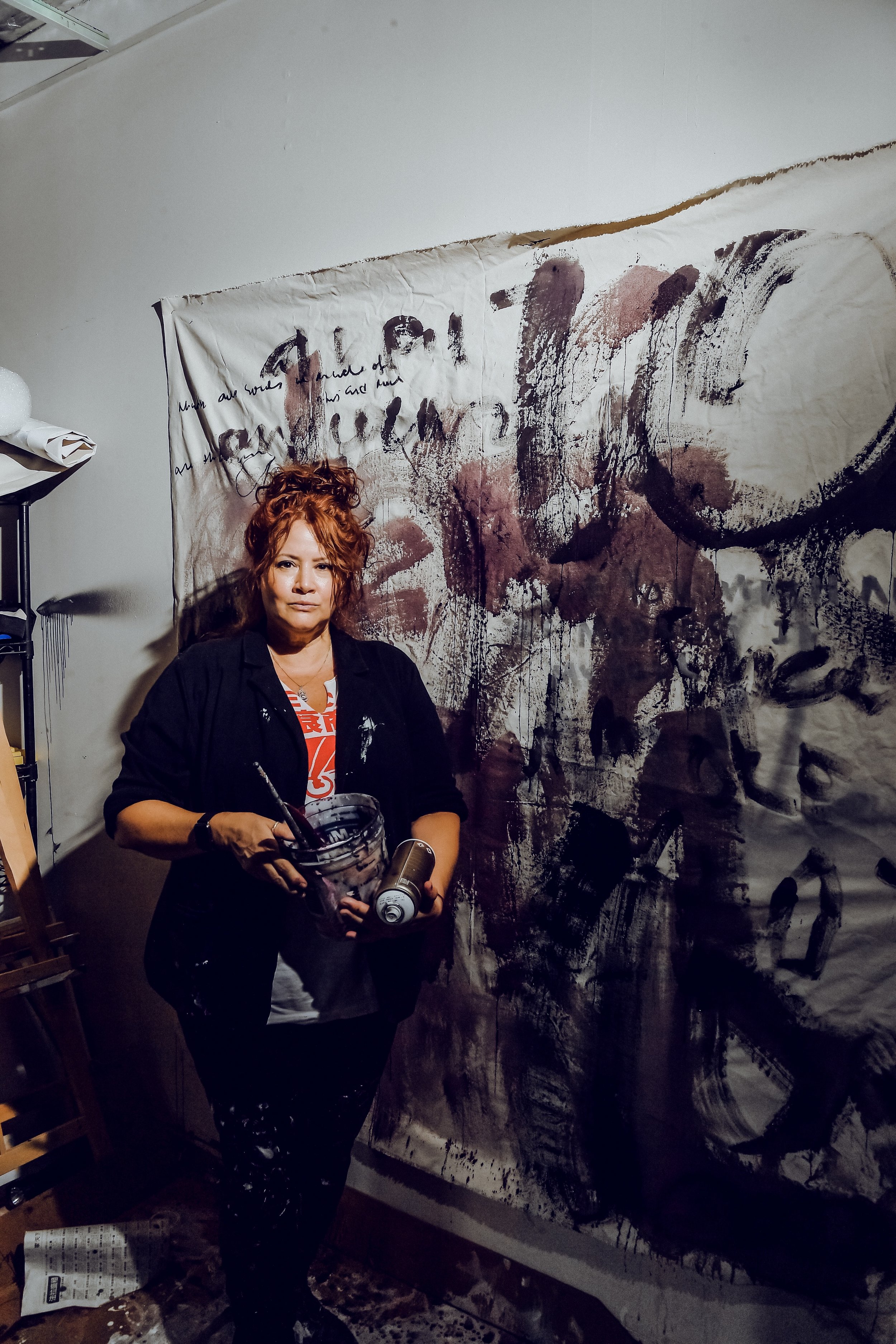
Her current practice moves between abstraction and figuration. Alongside her ongoing Subway Sonnets body of work, Washington creates large-scale commissions and works with designers on residential and hospitality projects. Recent bodies of work include Project Visage, centered on female identity and strength, and Content Not Found, which examines women, history, cultural memory, and the consequences of erasure.
ARTIST STATEMENT
I never considered myself a storyteller, until I did.
My paintings are visual narratives built from memory, place, identity, language, and the fragments of culture we absorb throughout our lives.
The visual language of my work began in New York.
I grew up surrounded by surfaces that were constantly being rewritten: graffitied subway cars, public telephone booths, storefront gates, punk posters, handbills, advertisements, stickers, political messages, and marks left anonymously in the street. Nothing remained pristine for long. Images were pasted over other images. Words were crossed out. Paint was scratched, weathered, written over, and reclaimed.
That accumulation still informs the way I paint.
My surfaces develop through a process that feels almost archaeological. Oil paint, spray paint, paper, photographs, typography, handwriting, and found imagery are layered, obscured, torn away, and rebuilt. Song lyrics and Shakespeare may occupy the same space as philosophy, advertising, street language, fashion imagery, religious symbols, or fragments of art history.
I am interested in what happens when these seemingly unrelated pieces begin speaking to one another.
Sometimes the resulting story is personal. Sometimes it is about a place or a memory. Increasingly, it is about identity - particularly the ways women are represented, mythologized, celebrated, misunderstood, or erased.
I move freely between abstraction and figuration because I don't see them as separate languages. A face, a word, a scraped field of paint, and a fragment of an old photograph can all carry memory. Each becomes part of the same accumulated surface.
My paintings don't offer a single narrative to be read from beginning to end. They operate more like memory itself: layered, contradictory, partially obscured, and continually being rewritten.
Photo Credit: @stuckphoto